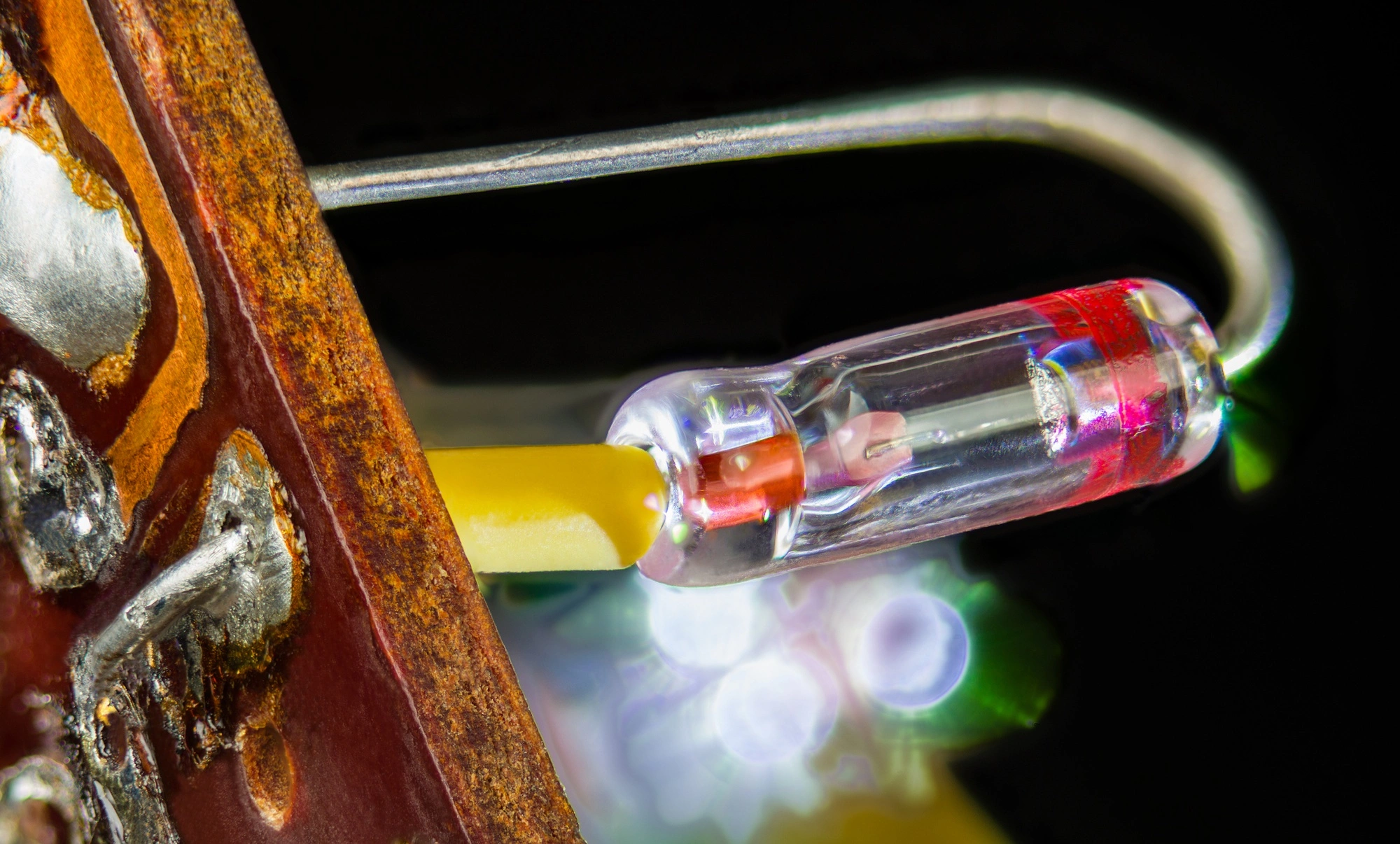
When we picture a transistor today, images of tiny silicon chips packed with millions, soon billions, of microscopic structures come to mind. But transistors weren't always this complex or ubiquitous. Once, they were innovative, hand-crafted fragments of advanced science, a far cry from the precision-engineered marvels we rely on today. Many of these early devices were based not on silicon, but on another material: germanium.
In the late 1940s, germanium held a place of honor in electronics history. It was at the heart of the world's first point-contact transistor, built in 1947 at Bell Laboratories by physicists John Bardeen and Walter Brattain. By pressing two fine gold contacts onto a small slab of germanium and applying a third connection beneath, they observed that the current flowing through the device amplified weak electrical signals. From that humble slab of brittle metalloid, modern computing was born.
Though silicon quickly overtook it because of its superior thermal properties, abundance, and wider bandgap, germanium was integral to the initial experimentation and successful commercialization of the transistor through the 1950s and 60s.
Despite their ingenuity, these devices were noisy and limited in both frequency response and gain. However, they brought affordability, accessibility, and reliability to the growing electronics industry, enough for countless engineers and hobbyists to begin honing their skills.
Not all germanium transistors were housed in glass. Metal-shell versions were also common, especially in applications that needed greater mechanical durability or shielding. The Russian-made P217, for instance, was used in military night vision equipment and features a metal housing, likely copper, for its conductivity properties.

Upon disassembly, some units display mysterious white powder, suspected to be an anti-moisture or insulating compound. Inside, one can usually find:
Certain models, like the AC128, were also filled with heat sink grease to manage thermal performance better. This specific transistor had a vertically mounted base plate with contact pins carefully anchored to the top and underside of the germanium wafer, again avoiding direct contact with the mount to maintain electrical isolation between the junctions.
Over time, silicon emerged as the champion of semiconductors. It could handle higher voltages and temperatures, gave more consistent performance, and was far more abundant. Notably, silicon's wider bandgap meant better "off" states, ideal for fast-switching digital electronics.
Nevertheless, germanium didn't disappear. It remained useful in specific applications, particularly where high-speed performance was essential, such as in radio frequency components, early integrated circuits, and infrared optics. Even today, germanium's superior electron and hole mobilities make it a compelling alternative as the search continues for the next generation of high-performance, low-power transistors.
While silicon reigns supreme in modern chips, researchers have never quite abandoned germanium. Its carrier mobility is still unmatched in many respects. In recent years, companies like IBM have experimented with CMOS designs using silicon-germanium channels, and thin-film germanium layers grown onto silicon wafers offer new opportunities for high-speed, energy-efficient transistors.
Engineers have demonstrated that electrons in germanium travel nearly three times faster than in silicon, and "holes" (electron deficiencies that act like positive charges) move roughly four times faster. This could enable faster switching speeds and lower energy requirements, two key challenges in today's computing environments.
Germanium-involved technologies, including nanowire transistors and even novel approaches like vertical-channel FETs (field-effect transistors), are under active exploration. Integration challenges remain, notably in aligning germanium with silicon at an industrial scale. However, the future may well feature hybrid circuits that combine the strengths of both.
At Quest Metals, we recognize the enduring value in these tiny pieces of technology. That's why we're actively purchasing vintage germanium transistors for environmentally responsible recycling. The germanium inside these components remains a valuable, reusable resource, and by recovering it, we're helping ensure that yesterday's innovations support tomorrow's breakthroughs.
If you have obsolete stock, failed components, or bulk lots of germanium transistors, reach out to Quest Metals. Let’s work together to give these rare and historic materials a second life—sustainably.