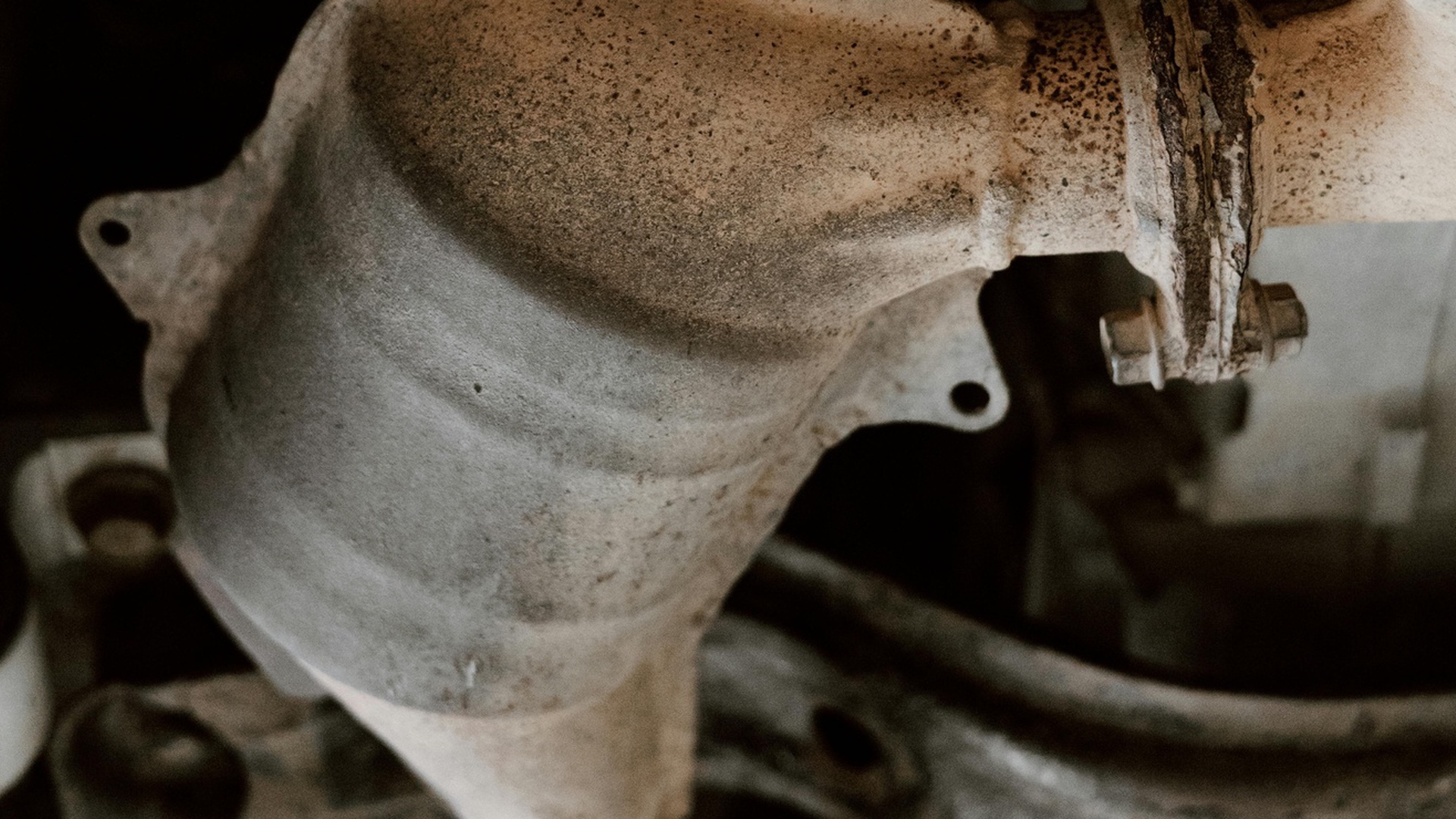
A catalyst is more than just a steel canister full of precious metals. Pt, Pd, and Rh are spread over a porous washcoat, which is in turn held on a support substrate. Since the widespread introduction of the catalytic converter in the 1970s, the washcoat and substrate have undergone numerous iterations to improve exhaust cleaning and the unit's durability. Each iteration has, in turn, changed the material that ends up in a recycler.
Emissions requirements from the 1970 Clean Air Act amendments drove the uptake of catalytic converters on U.S. vehicles for the 1975 model year. Some early designs used loose, porous alumina pellets coated with catalytic metals. The large surface area of the pellets made them an excellent catalyst support. The downside of a packed bed was that it was heavy, it restricted exhaust flow, and it took a long time to warm up. Road vibration and exhaust pulses could also abrade the pellets, leading to the loss of valuable catalyst-bearing dust.
For the recycler, the pellet design was fairly simple, really (some had a plug through which the beads could be removed). The main issue was retaining the fine material produced by wear, rather than maintaining a solid core. Around the same time, manufacturers began moving to ceramic honeycomb monoliths. Extruded cordierite (a magnesium aluminosilicate) formed a single block of straight, parallel channels. It had a very low coefficient of thermal expansion so that it could withstand rapid heating and cooling, and the open channels meant much less back pressure than you'd have with a packed bed. The honeycomb became the dominant substrate design. That shift, of course, changed the recycler's first job. Instead of just pouring the beads out, you now had to cut the steel housing open, remove the coated ceramic core, and crush it. Dust capture was essential, as the dust released during decanning and milling could contain quite a bit of precious metal.
As engine controls improved, more and more petrol vehicles started using three-way catalysts to oxidize CO and unburnt hydrocarbons while reducing NOx. The metals played different roles: platinum and palladium were key to oxidation, and rhodium was key to NOx reduction. Formulations varied from vehicle to vehicle, depending on the vehicle's design, emissions regulations, and metal prices. The look of a converter therefore told you very little about its actual Pt/Pd/Rh content.
The washcoat was developed alongside the metals. Bare cordierite has far too little surface area to be an effective catalyst, so they coated it with porous alumina and other materials. Ceria was introduced to store oxygen when the exhaust was oxygen-rich and release it when it was oxygen-poor, helping the catalyst work through small variations in the engine's air/fuel ratio. Later, ceria-zirconia formulations were developed, which withstood heat better and had improved oxygen storage capacity. The honeycomb itself also evolved. Early monoliths typically had around 200 cells per square inch and fairly thick walls. Later designs used higher cell counts and thinner walls. More channel surface area and less ceramic mass meant the converters heated up much faster after a cold start (when emissions are particularly high).
For the recycler, the ceramic core became more complicated. The precious metals were finely dispersed throughout a washcoat of alumina, ceria, and zirconia rather than being on the easily handled beads. Valuation became much more dependent on crushing the whole batch, mixing it thoroughly, and taking a sample. XRF could screen the material, but variation in washcoat chemistry required more rigorous analysis for final settlement.
Tighter emissions limits led to thinner-walled honeycombs with even higher cell densities. These substrates heated up quickly but could be quite fragile when removed. Any broken ceramic and washcoat dust had to be collected and fed into the batch, as it would otherwise be a loss of value before the refining process even began. In some applications, corrugated metallic foil substrates replaced ceramics. The foil's thin walls and low thermal mass offered packaging and robustness advantages but introduced a different recycling stream: metal foil cores that require different shredding and separation than ceramic honeycombs.
Diesel particulate filters, and later gasoline particulate filters, added another component to the exhaust system. They have a pair of channels plugged at one end and the other, forcing exhaust through porous walls that trap soot. As the soot builds up and is periodically burned off, the filters must withstand very high temperatures. Some are made of cordierite, some of the more heat-resistant silicon carbide, and some of aluminum titanate. A filter is not necessarily the same as a conventional PGM bearing converter. PGM content depends on whether it is catalyzed and how it is catalyzed. The recycler must identify the component to assign a value or send it to the smelter. Silicon carbide units, in particular, may need to be segregated because they behave very differently from cordierite during smelting.
Today's recycler takes in a mix of housings, ceramic honeycombs, metal cores, and particle filters, with varying amounts of precious metal and in different chemical environments. Used components can also contain moisture, soot, and oil-derived ash. After decanning, the ceramic is milled and homogenized so a small lab sample represents the batch. Weight loss on heating differentiates dry, processable material from moisture and combustible residues.
Refiners then recover the metals dispersed through the heat-resistant oxides. Smelting uses a collector metal to pull the platinum group metals away from the ceramic, and the slag chemistry has to be appropriate for the incoming substrate. Subsequent chemical refining then separates the individual metals; rhodium in particular can be very difficult to recover if it's aged and has bound itself tightly to the washcoat. The story from pellet to honeycomb is the story of two industries co-evolving. Converter designers have made substrates lighter, quicker to heat, and more robust, while washcoat chemists have made smaller quantities of precious metal do more and last longer. Recyclers have, in turn, moved from simply emptying loose beads to identifying complex components, capturing fine dust, producing representative assays, and tailoring recovery to the material inside each housing. For those ready to recycle, Phoenix Refining will take used catalytic converters and help turn end-of-life units into a source of recoverable precious metals.